


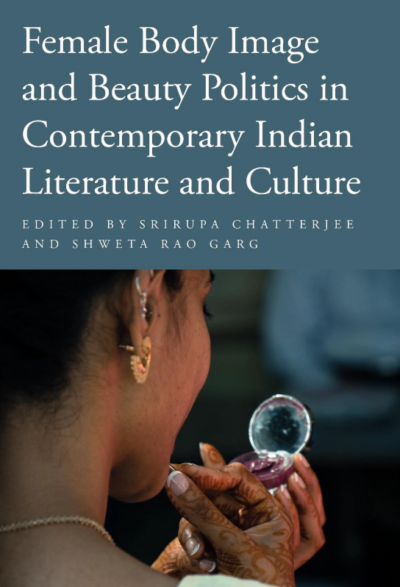
Female Body Image and Beauty Politics in Contemporary Indian Literature and Culture
Author Name: Srirupa Chatterjee & Shweta Rao Garg (Editors)
Book Publisher Name: Temple University Press
Publication Date: May 10, 2024
Number of Pages: 280
Edited by Srirupa Chatterjee and Shweta Rao Garg, Female Body Image and Beauty Politics in Contemporary Indian Literature and Culture is a necessary intervention against the tyranny of beauty rampant in the South Asian socio-cultural paradigm. The editors and the twelve other contributors to the volume initiate a theoretically framed inquiry into female body image and self-perception in India’s neoliberal and postcolonial cultural landscape. It has long been understood that there exist many rigid aesthetic codes across the world that constrain a woman’s bodily freedom. The book operates on the premise that, at least in India, the majority of the studies related to this area are confined to abuse, virginity, fertility and ageing. And as a result, the book addresses this lack of attention by emphasising the enormity of the labour involved in beauty regimes and the subsequent psychological toll on women.
Since body image is not a fixed concept, multiple definitions that capture different types of its impact exist. The central conception of the anthology is that the body image is an “interplay between embodied experience, identity and display” (p. 28). Here, any modification or reconciliation by the individual is spatially and culturally situated. The core thesis of the book, according to Chatterjee’s introduction, considers liberalisation a turning point that amplified the nation’s obsession with appearance and its gradual development into a social capital. The pre-liberalisation era in India was largely dominated by state-run channels like Doordarshan, with a clear nationalistic philosophy, and access to global markets was minimal. With liberalisation, new satellite channels, foreign goods, and pageant cultures were broadcast on a larger scale. It is not to say that such restrictions did not exist before, as India was already entrenched in various hierarchies rooted in caste, class and colonial influences. Liberalisation, in that sense, was not inventing, but simply disseminating. The volume seeks to map a range of cultural sites that perpetuate the idealisation of the female body through literature, media, advertising, and the internet, while also highlighting the marginalised embodiment. Hence, methodologically, the book moves beyond ethnography to detailed textual, visual, and discourse analysis. Accordingly, the content is structured into five categories, each addressing a specific layer of the issue.
The first section of the book predominantly focuses on marginalised bodies and the process of ‘othering’ within the hegemonic structure of beauty. Sangati (1994), a novel by Tamil Dalit feminist and novelist Bama, provides the groundwork for Nishat Haider’s study of the Dalit body. Drawing on the anthropologist Peggy Reeves Sanday, the Dalit body image and its development are situated within the mutually constitutive dynamics of society and the body. Similarly, by using Manju Kapoor’s A Married Woman (2002), Abha Dawesar’s Babyji (2005), and A. Revathi’s The Truth about Me: A Hijra Life Story (2010), Tanupriya and Aratika Bose seek to draw readers’ attention to women who occupy lesbian and transgender bodies. The authors here examine how nonnormative bodies negotiate with the heteronormative ideals and get traumatised by it as a result (p. 12). The central aim of the book is to construct a critical language that encompasses the competing vocabulary of the marginalised body (p. 40). Patriarchy maintains the dominance of the male gaze that is essentially heterosexual, and women internalise it as well as perform for it. The rigidity of beauty norms is questioned again in the second section, which explores the works of contemporary Indian women writers such as Shashi Deshpande, Manjula Padmanaban, Sowmya Rajendran, and Priya S. Chabria. A woman’s self-identity in relation to her appearance is firmly rooted in relationships, desirability, and the extent of commodification. Subjection to endless surveillance and body shaming makes the idea of body image a discursive construct compared to a biological reality (p. 12-13). Society convinces women of certain physical inadequacies, and this burden often forces them to occupy the fringes. Annika Taneja’s chapter on fictional dystopias offers insight through harsher, prescriptive futures that retain relatability while conveying a foreboding nature.
The range of non-normative embodied experiences covered is the anthology’s key strength. This is further exemplified by the third section’s focus on body image in contexts of disability and disfigurement. Chapters by Arunima Chanda and Samrita Sinha illustrate the intersection of ableism and gender. Chanda’s analysis foregrounds the importance of narratives that grow beyond sympathy to construct an oppositional gaze of functionality. It is through this oppositional gaze that liberating ways of viewing a disabled body can be achieved (p. 127). Sinha’s analysis of the movies Margarita with a Straw (2014) and Kuch Bheege Alfaaz (2018), on the other hand, highlights subjectivity and desire while also sensitising the readers to the aesthetics vis-à-vis disability (P. 14). A destabilisation of ableist semantics through the pursuit of selfhood and self-expression is essentially a challenging of the prescriptive body aesthetics (p. 143). The fourth section on scopophilic cultures is a vehement critique of fetishisation. Shailendra Kumar Singh’s analysis of regional cinema exposes the constant stigmatisation and erasure often linked with dark skin tone (p. 150). Indian cinema depends on dark skin to portray poverty, illiteracy and rurality, while the ‘fat female’ representations in Bhojpuri cinema end up being a voyeuristic fetish that subverts class boundaries of desire. The criticism of this redundancy sharpens the anthology’s core arguments. The final section aptly situates body image within the broader context of consumerist discipline. Here, modern terms like choice, empowerment, self-care and improvement act as masks to sell whitening products, harmful obsession with thinner bodies like the “Yummy Mummy” phenomenon- a strategic marketised move – to discipline bodies to the normative standards (201). The final chapter by Ketaki Chowkani examines case studies and real-life scenarios through autoethnographic accounts of tomboys. The nonnormative corporeality of tomboys is not framed solely by their numerous anxieties but also by the rebellion they mark against the ideal.
Ending on a dual note through Shweta Rao Garg’s conclusion, the anthology offers an honest critique of mainstream patriarchal and capitalist discourses, while also acknowledging the platforms that allow individuals and groups to voice their dissent. Thus, by emphasising and encouraging a space for resistance, the work establishes hope as a parting note. Although theoretically rigorous, the book is not intended solely for scholars of body image. The struggle against oppressive beauty norms is culturally and regionally situated, yet universal in the psychological costs it exacts. The examples and primary materials analysed are accessible and embedded in everyday life, often illuminated through instances of micro-activism. This anthology successfully continues the lineage of other critical works like Naomi Wolf’s The Beauty Myth (1990), Evelyn Nakano Glenn’s Shades of Difference: Why Skin Colour Matters (2012), Catriona Mitchell’s Walking Toward Ourselves: Indian Women Tell Their Stories (2016), Nina Kulrich’s Skin Colour Politics: Whiteness and Beauty in India (2022), etc, and lights the way for more critical conversations on the intersectional dimensions of the beauty hegemony. The editors’ strong commitment to promoting awareness and advocacy for body positivity and inclusivity underscores the volume’s ethical integrity and relevance in present-day India.
Salini K is a Senior Research Fellow currently pursuing her doctoral degree in the Department of English at the University of Calicut, Kerala, India. Her doctoral work focuses on Fan Studies and Media and Cultural Studies, with a special interest in Identity theories, focusing on relationships, performances, and creativity. She holds a Bachelor of Arts (2018) and a Master of Arts (2020) in English Language and Literature, also from the University of Calicut. She has published and presented papers on various aspects of digital culture, including fan platforms and other social media tools. Her broader academic interests include celebrity culture, popular culture, gender studies, feminism, and psychoanalysis.
Review published May 8, 2026