


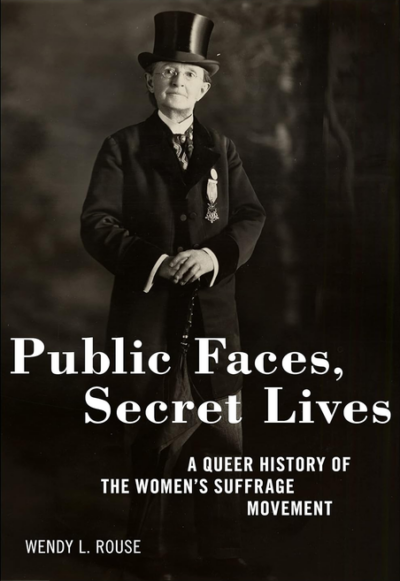
Public Faces, Secret Lives: A Queer History of the Women’s Suffrage Movement
Author Name: Wendy L. Rouse
Book Publisher Name: New York University Press
Publication Date: May 24, 2022
Number of Pages: 240
In her groundbreaking third monograph, Public Faces, Secret Lives: A Queer History of the Women’s Suffrage Movement, Wendy L. Rouse becomes the first historian to create a comprehensive history of the critical role LGBTQ+ activists played in securing women’s right to vote. The book highlights lesser-known queer suffragists from the late nineteenth century to the ratification of the Nineteenth Amendment in 1920, who have been erased from the movement’s history both by fellow suffragists and generations of scholars. Rouse argues queer suffragists played a crucial role in winning women’s right to vote, often adopting respectable public personas aligned with cisgender, heteronormative standards while privately maintaining queer relationships and identities. Throughout, the author proves the centrality of these narratives to the success of the movement, compelling scholars to continue queering future suffragist studies to combat the historical erasure of LGBTQ+ people.
In the introduction, Rouse carefully denotes the difference between the terms “queer” and “queering,” both appearing frequently throughout the book. She uses “queer” as an umbrella term for “suffragists who were not strictly heterosexual or cisgender” (p. 2), in place of assigning them contemporary labels – like lesbian or transgender – that suffragists may not have assigned themselves. “Queering,” however, operates as a framework for “deconstructing the dominant narrative” (p. 3). Rouse states scholars have begun queering the history of the women’s suffrage movement by examining the roles of race and class, and she adds to their analysis by considering how these identities interacted with, informed, and challenged cisheteronormative standards of the movement. While Rouse employs queering as a methodology for her own work, she argues suffragists themselves also queered the fight for the vote, as their lives transgressed acceptable standards of sexuality and femininity.
Rouse uses her first chapter to contextualize the pressures suffragists faced to publicly abide by cisheteronormative standards. Due to early oppositional rhetoric that framed women suffragists as “mannish” and men as “feminine,” gender subversive activists were deemed sexual inverts who embodied the threat of homosexuality (p. 12). This conflation imperiled the movement’s popularity and subsequently pushed suffragists to regulate their queer members’ public personas or even refuse their participation.
The following chapter centers on forms of “queer domesticity,” coined by historian Nayan Shah, that disrupted white cisheteronormative living standards. This included itinerant living and Boston marriages, which allowed suffragists to harbor secret queer relationships in their households while creating public personas in line with movement standards. Rouse extends Shah’s theory beyond homosexual households, considering suffragists who transgressed acceptable notions of home through living independently as spinsters. Chapter three focuses on queer families, defined by anthropologist Kate Weston as challenging “the hegemony of biological families while also ironically assimilating to heterosexist society”(p.67). Rouse builds on Weston’s work, which examined queer communities in the 1980s, to assert a longer tradition of found family, identifying several queer family formations in the late nineteenth and early twentieth centuries. In these chosen families, Rouse argues, queer suffragists supported each other’s emotional and financial needs while simultaneously developing personas, such as the loving mother, that matched societal expectations.
Chapter four contends that romantic and platonic relationships between suffragists in the UK and US, like that of Margaret Foley and Hellen Elizabeth Goodnow, facilitated the transfer of British militant feminist ideology to the US. Rouse asserts the devotion of American suffragists to their British partners pushed them towards public demonstrations over their previous tactics of private lobbying. Chapter five develops upon ideas of “queer space” – defined by geographers David Bell and Gill Valentine as the practice of LGBTQ+ people creating places of resistance within dominant cisheteronormative culture. Rouse uses queer space not only to signify places where queer suffragists operated, but also to “refer to sites where suffragists flouted sexual, gender, class, and racial norms” (p.118). The author’s focus on how women of color, such as Indigenous suffragist Marie Bottineau Baldwin, claimed queer space through integrating exclusive white feminist clubs provides an excellent example of how queering the suffrage movement intersected with the deconstruction of white, upper class norms alongside cisheteronormativity.
Rouse’s final chapter, “Queer Death,” is perhaps the most powerful articulation of how queer suffragists claimed love and intimacy despite marginalization within the larger women’s rights movement. Rouse pulls from Judith Butler’s idea of “ungrievable lives” among other scholars of queer death to assert implementing heteronormative death rituals – including memorials, interment, and legal enactments of probate – allowed queer suffragists to “memorialize their love” (p. 166). Rouse argues this act, more than any other discussed throughout the book, leaves traces for “perceptive historians and biographers to diffuse the murky obscurity that prevents us from seeing the true nature of their queer relationships” (p. 167). By looking to death, a long-buried history of queer lives in the suffrage movement can be uncovered.
While the importance of Rouse’s work in the scholarship of the women’s suffrage movement cannot be understated, greater explorations of queer members assigned male at birth (AMAB) would have strengthened the narrative. While she extensively highlights suffragists assigned female at birth like Dr. Mary Walker, Annie Tinker, Dr. Margret Chung, and Albert E. De Forest who transed/subverted gender, Rouse offers only a single example of a queer AMAB advocate. The author’s examination of Vaudeville female impersonator Julian Eltine’s work in the movement is incredibly interesting and left me wondering if there are any more stories like his.
While this critique offers a point of potential expansion, Rouse’s work is groundbreaking in integrating queer narratives into the larger history of the women’s suffrage movement. Her clear writing style punctuated by accessible definitions of the queer theories she employs and concise conclusion sections in each chapter makes reading Public Faces, Secret Lives feasible not only to scholars, but also to lay audiences. Where academics will benefit from a commendable example of interdisciplinary queer research, general audiences will walk away with a knowledge of everyday queer suffragists neglected in history class. With its broad potential readership, Rouse’s work successfully reincorporates queer lives into the history of the women’s rights movement.
Peyton Meyer is an MA student in History at the University of Oregon studying under Dr. Annelise Heinz. Her work primarily focuses on twentieth century queer history in the United States, and implements interdisciplinary approaches from women’s, gender, and sexuality studies. This year she will complete her thesis centered on lesbian comedy and performance as a form of protest against anti-gay legislation in the state of Oregon in the late 1980s and early 1990s.
Review published August 27, 2026